

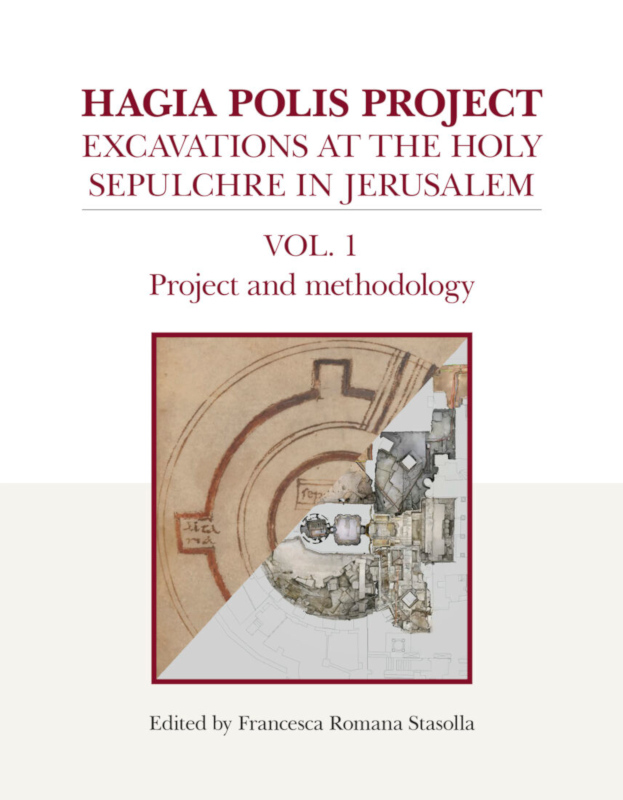
Francesca Romana Stasolla (ed.), Hagia Polis Project. Excavations at the Holy Sepulchre in Jerusalem. I. Project and methodology (Collectio Maior 60), Milano 2026
→ Scheda nel sito delle Edizioni Terra Santa
The book inaugurates a monumental multi-volume series devoted to the scientific study and conservation of Christianity’s most revered sanctuary.
It presents the project and its methodology, tracing seventeen centuries of history embedded in the stones of the Church of the Holy Sepulchre.
Through an unprecedented collaboration among the Greek Orthodox, Catholic, and Armenian communities, and a multidisciplinary team of archaeologists, engineers, historians, and conservation scientists, coordinated by Sapienza Università di Roma, the book documents the comprehensive investigation of the church’s floor, substructures, and underground infrastructures.
Combining stratigraphic excavation, 3D GIS, advanced diagnostics, and rigorous archival research, it reveals the site’s transformation from quarry and garden to imperial basilica and global pilgrimage centre. Offering not only new data but also an innovative model for working within a living place of worship, this first volume lays the methodological and interpretive foundations for the subsequent books in the series.
Contents
Contributors
Prefaces
Acknowledgements
SECTION I. THE ARCHAEOLOGICAL PROJECT
- A challenging archaeological project, F. R. Stasolla
- Preliminary research results, F. R. Stasolla
SECTION II. THE PARTNERSHIP
- Osama Hamdan: a legacy of Heritage preservation and coexistence at the Holy Sepulchre, C. Benelli
- Restoring the Church of the Holy Sepulchre: a complex journey of preservation and faith, N. Nasser
- Preserving the historic flooring of the Basilica of the Holy Sepulchre in Jerusalem: methodological approach and intervention design, M. Cardinali, P. Croveri and D. Russo
- Monitoring of the structures of the Basilica of the Holy Sepulchre and assistance on site concerning structural safety during archaeological excavations, M. Pepe, V. Peisino and M.Battaglio
- The technical subsystems of the Church of the Holy Sepulchre, R. Zecchin, P. Sette, G. Girardello and A. Fornasiero
SECTION III. THE DOCUMENTATION
- The archaeological materials from Coüasnon’s and Corbo’s excavations at the Holy Sepulchre (1960s-1970s) stored at the Studium Biblicum Franciscanum: an introduction, A. Ricco ofm
- The SAPP database: design and implementation of a relational GIS-linked system for the Church of the Holy Sepulchre in Jerusalem, B. Brancazi, S. De Togni and A. D’Alessandro
- Needles and haystacks scattered across Jerusalem: Dominican and Franciscan archival fonds for the study of the Holy Sepulchre, A. Ricco ofm
- Integrating advanced documentation techniques: a 3D GIS approach to the Holy Sepulchre excavation, N. Dell’Unto
- A 3D GIS Geodatabase for ensuring reproducibility in the archaeological excavation in the Holy Sepulchre in Jerusalem: methods, implications and initial data perspectives, F. Vacatello
- The case study of the North Rotunda, V. Mattia and C. Romagnoli
- Survey and architectural-stratigraphic analysis in confined spaces. The case of the cistern below the Rotunda of the Anastasis, A. Melega
- The offsite lintels of the Rockefeller Museum, P. F. Pistilli and J. Planamente
- The survey of lintels, A. Melega and L. Brancazi
- From digital documentation to 3D modelling: some interpretative hypotheses through the virtual relocation of the ‘‘missing pieces’’ of the Basilica of the Holy Sepulchre, M. D’Amico
- Field documentation protocols for technological traces: methods and objectives for the study of the Church of the Holy Sepulchre, C. Lemorini and G. Previti
- Photography and time-lapse at the Holy Sepulchre, G. Pinto Ostuni ofm
SECTION IV. THE WRITTEN SOURCES
- Before the Holy Sepulchre. Remembering Jesus’ burial, E. Zocca
- The Holy Sepulchre as martyrion: history and archaeology, P. Vannicelli
- On imperial presence in Palaestina. Epigraphic evidence of the 4th Century, G. L. Gregori
- An overview of Byzantine literary sources on the Holy Sepulchre of Jerusalem, L. D’Amelia
- The topography of Jerusalemite spirituality through the Byzantine itineraria. An analysis between perception and archaeological materiality starting from the Holy Sepulchre, A. D’Alessandro
- Text and experience: evolving memories of Jerusalem in Latin pilgrimage literature, A. Musarra
- Medieval Latin philology and the Holy Sepulchre, P. Garbini, G. Evangelisti, C. Bellaveglia and S. Mangiatordi
- Jerusalem in ancient Armenian historiography (5th-13th century). A preliminary study, M. Bais
- Ottoman sources for the Holy Sepulchre: some preliminary considerations, M. Di Branco and P. Papachartofyli
SECTION V. THE ARTEFACTS
- Contexts, assemblages and materials. Observation on the material culture of Jerusalem from prior knowledge and new data from the Holy Sepulchre excavation, A. F. Ferrandes
- Engineering approaches to support archaeological studies through 3D reconstruction, L. Belluomo, M. Bici and F. Campana
- Metal objects in the archaeological record of the Holy Sepulchre. Post-medieval artefacts from the Rotunda, F. Bisceglia
- Coin finds from the excavations at the Holy Sepulchre, Jerusalem, A. Polosa and E. Molaioni
- Two Greek inscriptions, A. E. Felle
- A hatch to the past: archaeological analysis of a modern deposit (19th-early 20th century), L. Brancazi, G. Previti, E. Cerafogli, A. Masi and L. Sadori
- First operations to store paper fragments, A. M. Campus and A. Morgia
SECTION VI. CONTEXT AND ENVIRONMENT
- Archaeobotanical studies, E. Cerafogli, A. Masi, C. Moricca and L. Sadori
- Archaeometric analysis of geomaterials from the archaeological excavation, M. Di Fazio, L. Calzolari, S. Capriotti, C. Rea, S. Mignardi and L. Medeghini
- Faunal remains from the Holy Sepulchre. Archaeological perspectives on historical practices, L. Brancazi
- Archeobotanical and archaeometric analysis of soil remains from Area K, G. Favero, A. Ciccola, C. Moricca, A. Masi, L. Sadori, M. Di Fazio, L. Calzolari, S. Capriotti and L. Medeghini
SECTION VII. FROM THE PROJECT TO NEW RESEARCHES
- Weaving the stone. Experimental study on the production of mosaic tiles from the Holy Sepulchre complex in Jerusalem, B. Brancazi
- Christian Jerusalem: a database of Christian settlements in the Holy City, A. D’Alessandro
- Non-invasive techniques for the taxonomic identification of faunal remains from the Holy Sepulchre, L. Brancazi
- ArcheoSystem: precision robotic for indoor archaeological mapping, F. Vacatello
BIBLIOGRAPHY
Abbreviations
References