


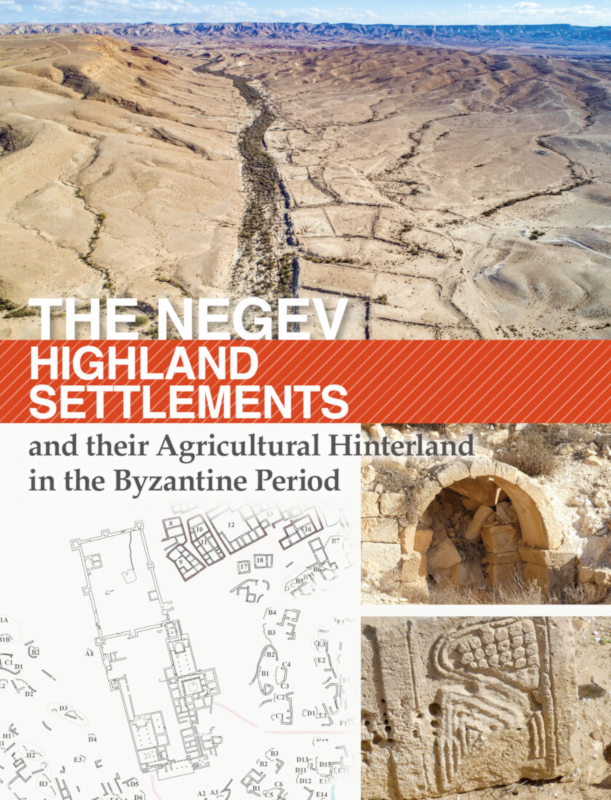
Ofer Sion - Yotam Tepper (ed.), The Negev Highland Settlements and their Agricultural Hinterland in the Byzantine Period (Collectio Maior 59), Milano 2025
→ Scheda nel sito delle Edizioni Terra Santa
This volume is the result of ongoing research; it seeks to present a summary of the most recent data on the Negev settlements in the Byzantine period and the agricultural systems which developed around them.
The geographical framework of the study was determined by the layout of the settlements in the northwestern Negev. The area is bordered by craters to the east and south, Be’er Sheva‘ and the Ḥaluẓa sand fields to the north, and the ‘Agur sand fields to the west. The Byzantine period was chosen as the chronological framework, beginning with the rise to power of Constantine in 324 CE.
The authors refer to the main settlement sites in the north of the Negev Highlands: Mamshit, the Yeroḥam Fortress, ‘Avedat, Shivta, Sa‘adon, Reḥovot-in-the-Negev and Niẓẓana. The research also includes a renewed look at the two urban settlements in the Negev: Ḥaluẓa and Be’er Sheva‘.
The first part of the book includes two sections: the geography and geology of the Negev, by N. Wieler, and the historical-epigraphic background, by O. Pogorelsky. The second part is devoted to the large settlements of the Negev and the agricultural systems around them, and to the two main cities in the region. The chapters of this part are based on the mapping of the settlements and the agricultural systems around them. This constitutes the main body of the work. With the exception of Be’er Sheva‘ (written by N.D. Michael), the remaining chapters were written by the authors. In each chapter, the history of the settlement and its research was compiled by N. Shemesh. The field study and mapping were written by O. Sion and edited by O. Sion and Y. Tepper.
In the third part of the book, four new studies are introduced that are published here for the first time. The first one, by T. Erickson-Gini and Y. Rapuano, discusses the ceramic forms at the transition from the Byzantine to the Early Islamic period. The second, by B. Callegher, deals with the Byzantine coins from the major settlements of the Negev. The third, by R. Shoeff and R. Linn, deals with conservation issues in three of the Negev settlements: Niẓẓana, Shivta and ‘Avedat. The fourth focuses on the roads and transit routes between the settlements and was written jointly by O. Sion, Y. Tepper, and N. Wieler.
By Ofer Sion, Yotam Tepper, Noy Shemesh and Alexander Wiegmann
Edited by Ofer Sion and Yotam Tepper
With contributions by Nimrod Wieler, Ofer Pogorelsky, Noé David Michael, Nicolas Benenstein, Tali Erickson-Gini, Yehudah Rapuano, Bruno Callegher, Ram Shoeff and Ravit Linn
Contents
Preface
Introduction
Abbreviations
Part I - Geomorphological and Historical Background
Chapter 1. Geomorphic Aspects of Byzantine Agriculture in the Negev Highlands (Nimrod Wieler)
Chapter 2. The Negev: An Historical Overview (Ofer Pogorelsky)
Part II - The Negev Settlements and their Surrounding Agricoltural Hinterland
(Ofer Sion, Yotam Tepper, Noy Shemesh and Alexander Wiegmann)
II A. The Cities
Chapter 3. Be’er Sheva‘ and its Hinterland during the Byzantine Period (Noé David Michael)
Chapter 4. Ḥaluẓa
II B. The Villages
Chapter 5. Reḥovot-in-the-Negev
Chapter 6. Ḥorvat Sa‘adon
Chapter 7. Niẓẓana
Chapter 8. ‘Ezuz
Chapter 9. Shivta
Chapter 10. ‘Avedat
Chapter 11. Mamshit
Chapter 12. Meẓad Yeroḥam (With the participation of Nicolas Benenstein)
Part III - Related Studies
Chapter 13. A Culture in Transition: Late Byzantine and Early Umayyad Ceramic Forms from the Negev Highland Sites (Tali Erickson-Gini and Yehudah Rapuano)
Chapter 14. Coins and the Economy in the Negev between the 4th and the 7th Centuries CE (Bruno Callegher)
Chapter 15. The Conservation and Presentation of Byzantine Sites in the Negev (Ram Shoeff and Ravit Linn)
Chapter 16. Major Roads and Transit Routes along the Agricultural Systems and Between the Byzantine Settlements in the Negev (Ofer Sion, Yotam Tepper and Nimrod Wieler)
Part IV – Discussion, Summary and Conclusions
Chapter 17. Discussion, Summary and Conclusions (Ofer Sion and Yotam Tepper)